The Brandenburg Gate: A Symbol of Endurance Amid Turbulent Change
by Paige Walker
Likely the most recognizable symbol of Berlin today, the Brandenburg Gate, or Brandenburger Tor, is a must-see destination for visitors, along with the Reichstag, Berlin Wall, and Checkpoint Charlie. Today, the gate sits between Pariser Platz, home to many foreign embassies and museums, and the Tiergarten, a lovely place to escape the business of the city and stroll through nature, so locals and tourists alike often pass through the gate. More than just a remarkable monument, the Brandenburg Gate has been a powerful symbol of peace, victory, division and unity throughout Germany’s history, and has stood as witness to the most pivotal moments.
The Construction of Brandenburg Gate

Brandenburg Gate is the last remaining town gate from the Akzisemaur, or Berlin Customs Wall, that closed in the old inner city during the rule of King Friedrich Wilhelm I of Prussia in the 17th century. The king commissioned the construction of the gate in order to control taxes on goods being brought into the city. Brandenburg Gate holds a prime location on the Western end of Unter den Linden and originally led up to the Prussian Palace, so it was a very busy checkpoint.
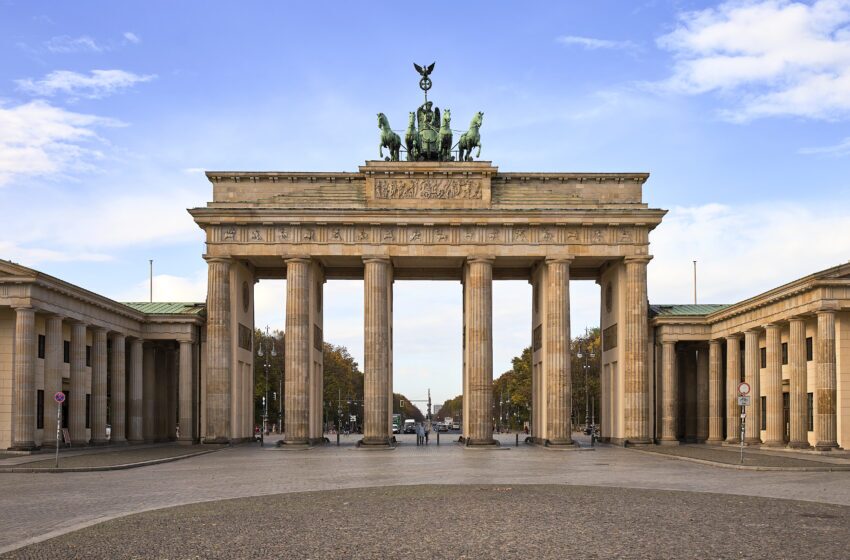
The first rendition of the Gate was completely different from how we know it today. Known as the “Tiergarten Tor” due to its close proximity to the Tiergarten, the gate was originally just a humble collection of pylons to house the guards. King Frederick William II, keen to create cultural monuments to rival those in Vienna, Paris, and London, hired court architect Carl G. Langhans to reconstruct the gate in 1788. Langhans modeled the gate after the Acropolis in Athens, an enduring symbol of Ancient Greece, to carry on its cultural legacy and represent peace at a time of religious struggle for the Prussian empire. The Doric columns of the five smaller “portals” within the gate as well as the decorative reliefs of Greek mythology reveal the original inspiration.
The middle portal was historically reserved exclusively for royalty and other important state figures to pass through as a way to reinforce the power and prestige of the Prussian monarchy. Everyone else had to walk through the smaller side arches.
The gate is flanked by two smaller buildings: Haus Libermann and Haus Sommer. The originals were unfortunately destroyed in World War II, so faithful reconstructions stand in their place.
The Quadriga statue on the top of the gate, added in 1793, depicts Eirene, the Greek goddess of peace, and Nike, the Greek goddess of victory. The original orientation faced the Quadriga towards the center of Berlin. Underneath are reliefs intended to personify friendship, statesmanship, arts, and science along with a description that says “Zug der Friedensgöttin” or “train for the goddess of peace” to demonstrate the wealth of the Prussian empire. This construction of the Brandenburg Gate gave Berlin the nickname of “Spreeathen” or “Athens of the Spree River.”
Napoleon’s Theft and Prussian Reclamation

During the French conquest of Prussia from 1806-1812, Napoleon paraded his troops into Berlin under the Brandenburg Gate to signal the triumph of the French in Berlin. He claimed the Quadriga for himself, hauling the statue to Paris, where it was kept as a spoil of war for eight years.
In a dramatic reversal, when Prussian troops claimed victory over Napoleon in 1814, they managed to retrieve the Quadriga and restore it to Berlin, where it would represent a new, triumphant age of Prussian politics. The statue was transformed to represent only victory, with a Prussian eagle carrying an Iron Cross replacing Eirene’s laurel wreath as a tribute to the bravery of the Prussian soldiers, and it was rotated towards Prussian neighboring states as a threatening message to their enemies. Right in line with that message, Prussia soon set its own sights on Empire.
The gate became a site of celebration: Prussian princes paraded their brides through the gate, distinguished visitors entered Berlin through the gate, and many military parades took place there. This made the gate a highly-regarded royal monument even as the rest of the Akzisemaur came down. But the gate’s significance had a dark turn in store.
Brandenburg Gate as Symbol of the Third Reich

During the Weimar Republic, all five of the gates were opened up to the public. As the country roiled with internal conflict, the Brandenburg Gate became the site of party quarrels, rallies, marches, strikes, and even an attempt to overthrow the government. The Weimar Republic thrived throughout the 1920s, but struggled after the onset of the Great Depression and collapsed after the election of Adolf Hitler as Reich Chancellor in January of 1933. SS troops marched through the Brandenburg Gate in celebration — yet another iconic moment in Berlin’s history featuring the landmark.
The Nazis soon adopted the gate as a symbol of the Third Reich, as it appeared on the German Reichsmark with a swastika replacing the Quadriga and Hitler’s portrait on the opposite side, and further laid claim by hanging five Nazi flags on each side of the gate. And the big plans of the Third Reich to alter the urban design of Berlin was monumentalizing the Brandenburg Gate as the Eastern end of a proposed East-West axis plan. This started in 1939 with the construction of Charlottenburger Chausee, a seven kilometer stretch between the Brandenburg Gate and Adolf Hitler Platz (now known as Theodor-Heuss Platz), which involved removing the two porticos so cars could pass. This plan was never realized, though, as World War II progressed and the gate was bombarded by Allied troops.
But, despite the widespread destruction, the Quadriga remained atop the pillars. In the final days of the war, a blockade was made around the gate, resulting in the final battle between the Nazis and the Soviets. When the Nazis surrendered, the Soviets planted their red hammer-and-sickle flags atop the Quadriga to claim victory.
Brandenburg Gate in the Cold War

Post-World War II, the Soviets destroyed many buildings in Berlin with Nazi connections, but the gate was spared. Already badly damaged, the Soviets likely saw the gate not worth the trouble to destroy, and it had already proved its power as a symbol they could repurpose. Located in Soviet-controlled East Berlin, the Gate became a sign of Soviet power and Cold War division. A massive Soviet flag was planted nearby to demonstrate who was in charge here.
The gate’s symbolic power could not entirely be controlled by the Soviets, however. In June 1953, 300 East Berlin workers went on strike through the gate to protest pay cuts by the East German government. Half a million citizens marched towards the Brandenburg Gate and burned the Soviet flags, replacing them with black, red, and gold German flags. Fifty people were killed and thousands arrested. Charlottenburg Chausse was renamed Straße des 17 Juni to memorialize this tragic event and protest Soviet actions.
Many more clashes between citizens and the East German enforcers followed this uprising before the overnight installation of the Berlin Wall in 1961. The Gate acted as a checkpoint within the wall between the East and the West, until West Berliners started staging major protests there. The East Berlin government then closed the checkpoint, placing the gate in the no man’s land known as the “death strip.”
In 1963, at the height of divisive tensions, President John F. Kennedy came to Berlin and delivered his famous “Ich bin ein Berliner” speech near the Brandenburg Gate, with the Wall looming in view behind him. His words of solidarity, hope, and courage resonated with residents of West and East Berlin alike, despite the Soviets’ attempt to block his view of East Berlin with giant red banners.
Divisions continued for another two decades, until 1989. That year, President Ronald Reagan visited Berlin and urged Soviet Chairman Gorbachev to “tear down” the Berlin Wall while standing in front of the Brandenburg Gate. In East Germany, crowds gathered for large demonstrations in October and November, protesting against the regime. Ultimately, the demonstrations led to free travel between the East and West overnight and marked the end of the Berlin Wall when on the 9th of November, large numbers of Berlin residents tore the wall down with hammers. All the other checkpoints were opened up in Berlin to traffic almost immediately, but the Brandenburg Gate’s symbolism and location in the death strip delayed its opening. On November 22nd, the gate was reopened with a large ceremony where the Chancellor of West Berlin and the Prime Minister of East Berlin walked through the gate together in a show of good faith and solidarity.
Restoration of Brandenburg Gate

The Gate underwent a two-year, six million Euro restoration to its original design. Throughout Berlin’s turbulent history, this monument has stood the test of time as a symbol of German identity. Whether you are a tourist, a student of architecture, or simply just visiting Berlin, the Brandenburger Tor commands a mandatory visit when one travels to Berlin.
Learn more about the Brandenburg Gate and other notable sites in the context of Berlin’s turbulent history with Insight Cities’ East Berlin Tour. See remnants of the Berlin wall, learn more about East Berlin’s “ghost” stations, and discover the relics of the Communist Era on our East Berlin tour. Our guides boast vast local knowledge as well as enthusiastic personalities that make your tour both enlightening and entertaining. So make your trip to Berlin an especially memorable one and book your tour with us today!